

Switchboard Upgrades in Terrigal, The Warning Signs Your Board Is Overdue
A Switchboard Tells You Before It Fails
A switchboard rarely fails without warning. Long before it stops working, it gives signs that it's struggling to do its job safely, and because the switchboard is the central control point for every circuit in a home, those signs are worth taking seriously. Most of them are easy to spot once you know what you're looking at, and catching them early is the difference between planning an upgrade on your own terms and dealing with a fault at the worst possible moment.
Ceramic Fuses Instead of Switches
The clearest sign is the most visible one. If the board still has the old porcelain plug-in fuses with fuse wire rather than rows of switches, it predates modern safety standards. Ceramic fuses don't protect people from electric shock the way a modern safety switch does, and they have to be rewired by hand when they blow, often in the dark, which is its own hazard. A board still running fuses is the strongest single indicator that an upgrade is overdue, regardless of whether anything has gone wrong yet.
No Safety Switches (RCDs)
Safety switches, RCDs, or the combined RCBOs used in modern boards, cut power in a fraction of a second when they detect current leaking to earth, which is what protects against electrocution. A board with only circuit breakers, or with no safety switches on key circuits, is missing that protection. Older homes sometimes have a single safety switch covering everything, or none at all; modern practice distributes protection across circuits so a fault in one area doesn't black out the whole house and the source of a problem is easy to isolate.
Frequent Tripping, Warmth, or Smells
A board that trips often, has breakers that feel warm to the touch, shows scorching or discolouration, or gives off a faint burning smell is telling you it's under stress. Sometimes that's a single faulty circuit that needs attention; sometimes it's a board that no longer has the capacity for a home's modern load of air conditioning, induction cooking, and appliances all drawing at once. Either way, it warrants an inspection rather than repeatedly resetting a breaker and hoping. Repeated tripping is a symptom, not the problem itself, and ignoring it lets a small fault become a larger one.
No Room to Grow
A board packed full with no spare ways is a practical problem as much as a safety one. Adding solar, a battery, an EV charger, or new circuits for a renovation all need space and capacity at the board. When there's nowhere left to add a circuit, an upgrade isn't just about safety, it's what makes any future electrical work possible. Many homeowners first discover their board is full when they go to add solar or a charger and find the project can't proceed until the switchboard is replaced.
What an Upgrade Involves
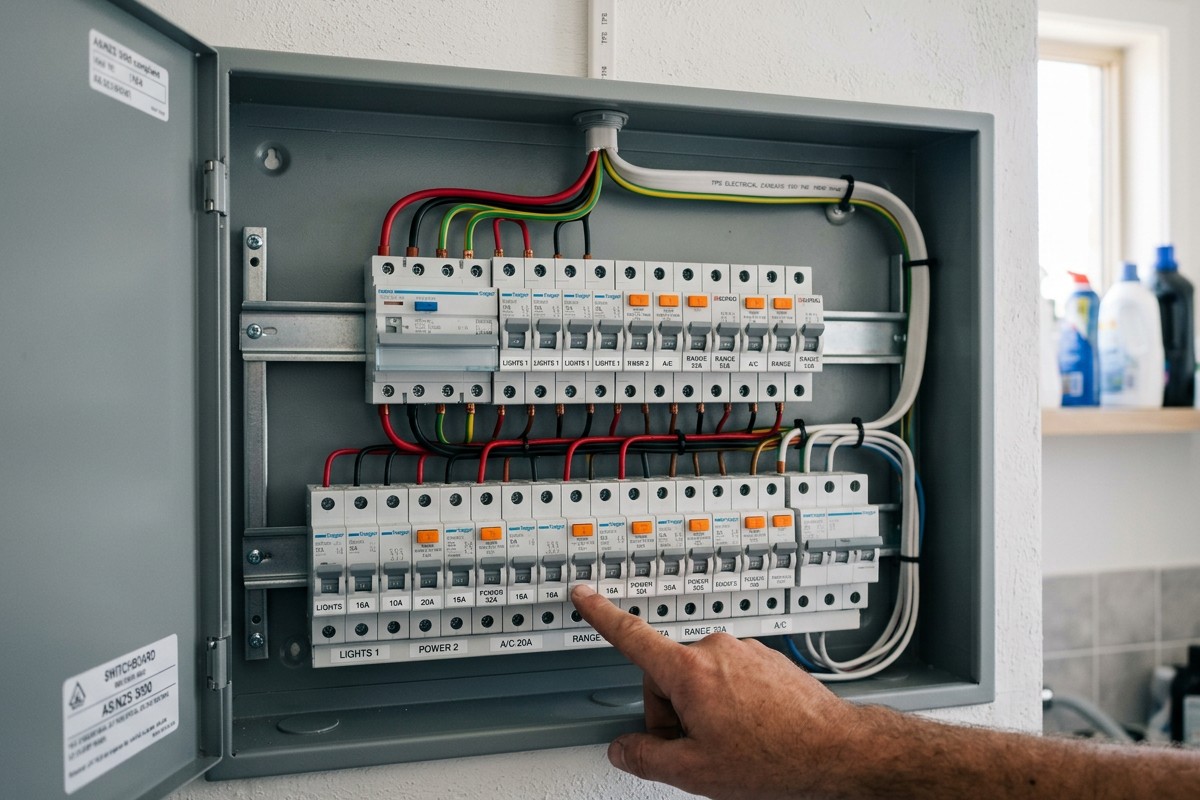
Upgrading a switchboard means replacing the old board with a modern enclosure fitted with circuit breakers and RCBOs arranged on a DIN rail, bringing the installation in line with the current AS/NZS 3000 wiring rules. A licensed electrician assesses the existing wiring, isolates the supply, fits the new board, tests every circuit, and certifies the work. The power is off for part of the day while the changeover happens, and a tidy modern board also makes every future job, fault-finding, adding a circuit, isolating a room, quicker and safer.
Frequently Asked Questions
Is an old switchboard actually dangerous, or just outdated?
It can be both. The real risk is the lack of modern shock protection that ceramic-fuse and RCD-free boards have. Outdated also means under-capacity for modern appliances, which is where overheating and nuisance tripping come from. A board can look fine and still be missing the protection a current installation would have.
Do I have to upgrade the board to add solar or an EV charger?
Often, yes. If the board is full or lacks the capacity and protection for the new load, an upgrade is part of the job. The electrician confirms this during the assessment, and it's worth checking early so the cost is factored into the bigger project rather than coming as a surprise.
How long does a switchboard upgrade take?
Most residential upgrades are completed within a day, with the power off for part of it. Boards with complex or non-compliant existing wiring can take longer, and the electrician will give a realistic estimate after seeing the board.
Will I need to be home during the work?
It helps to be available at the start and end. The power will be off while the board is changed over, so it's worth planning around the outage, moving anything in the fridge or freezer that matters and not scheduling work that needs power for that window.
Switchboard Showing Its Age in Terrigal?
Get a free, no-obligation site assessment from a local licensed electrician serving Terrigal and the Central Coast.