

Adding Power Points to a Terrigal Home, How Many and Where
When Every Room Has a Power Board
Most older Central Coast homes share the same quiet problem: not enough power points. The house was wired for a few lamps and a TV, and now every room runs a power board feeding chargers, screens, speakers, and appliances, with extension leads snaking under rugs. It works, until it doesn't, and overloaded power boards and daisy-chained leads are a genuine fire risk, not just an eyesore. Adding properly installed power points is one of the cheapest, highest-value electrical upgrades a home can have.
How Many Is Enough
There's no legal minimum that matches how people actually live, so the honest answer is "more than the house currently has, and more than you think." The useful approach is to walk each room and count what's plugged in plus what's run off a board or lead, then plan points to cover all of it with some spare. Kitchens, home offices, and entertainment areas are always the hungriest, benches with appliances, desks with computers and chargers, and TV walls with consoles, sound, and streaming boxes.
Double power points are the sensible default almost everywhere; the cost difference over a single is small and the second outlet is always used. In key spots, behind the TV, at a desk, beside a bed, doubles or even quad outlets save the power board entirely.
Where the Points Belong
Position matters as much as number. A power point in the wrong place still leaves you reaching for a lead. The spots worth planning carefully include: behind the TV (at the right height for a wall-mounted screen), either side of the bed for lamps and chargers, along the kitchen bench clear of the sink and cooktop zones, at desks and study nooks, in the garage for tools and a fridge or freezer, and outdoors for entertaining, the barbecue, and garden equipment.
Outdoor points are their own consideration. An external power point on a Terrigal home needs to be a weatherproof, appropriately rated outlet with a spring cover, an indoor outlet on an exposed wall is a hazard in coastal weather. Placing one near the alfresco area and another at the front or in the garden saves running leads out through windows and doors.
USB, Smart, and Specialty Outlets
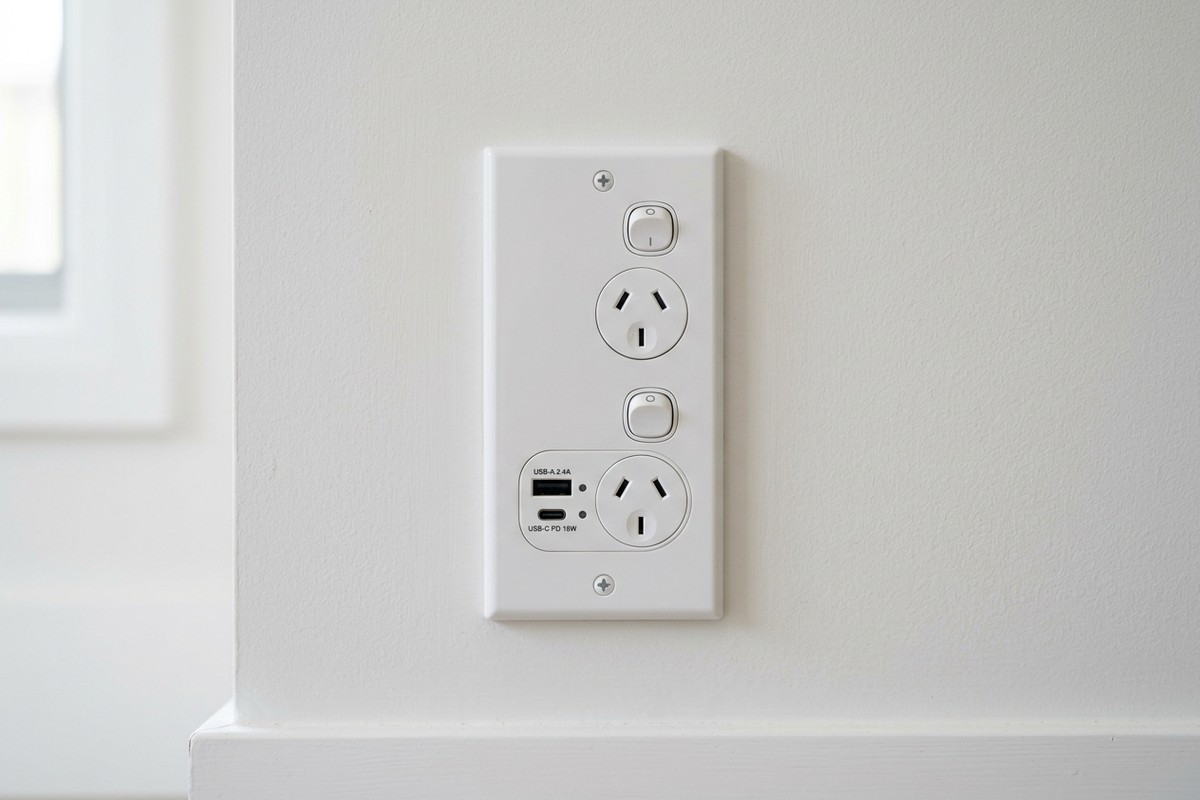
Modern outlets do more than carry 240 volts. Combination outlets with built-in USB-A and USB-C ports are popular bedside and at desks, charging phones and tablets without a plug pack hogging a socket. There are also outlets with built-in surge protection for sensitive electronics, and switched outlets for appliances you want to isolate easily. None of these change the wiring much, but they're worth deciding on before the electrician fits the points.
Why Leads and Boards Aren't the Answer
Extension leads and power boards are designed as temporary, light-duty solutions. Run permanently and overloaded, they overheat, especially when high-draw appliances like heaters or kettles are involved, which should always go straight into a wall outlet. Leads under rugs or through doorways add a trip hazard and wear through over time. Adding fixed power points where they're actually needed removes the clutter, the trip hazards, and the overload risk in one go, and it's a quick job for a licensed electrician on most homes.
The Right Time to Add Them
If a renovation, repaint, or new flooring is on the horizon, that's the moment to add power points. Walls that are already open, or about to be patched and painted, make running new outlets far easier and tidier, and the patching gets absorbed into work that's happening anyway. The same applies when a switchboard is being upgraded or a room rewired, adding outlets at that point costs far less than coming back for a standalone job later. It's worth walking the home before any such work and listing every spot that currently relies on a lead or a board, so the electrician can fold those points into the scope while access is easy.
Frequently Asked Questions
Can I add a power point myself?
No. Installing or relocating a power point is electrical work and must be carried out by a licensed electrician in NSW. Beyond the legal requirement, a badly terminated outlet is a real shock and fire risk, it's a quick, low-cost job done properly.
Is it better to add a double or single power point?
A double almost always. The extra cost over a single outlet is small, and the second socket gets used immediately, especially in bedrooms, kitchens, and around the TV and desk, where a single outlet just sends you back to a power board.
Can a power point be added to an existing wall without major mess?
Often, yes. An electrician can usually run a new outlet from a nearby existing point or through the wall cavity and roof space with minimal disruption. How easy it is depends on wall construction and access, which the electrician assesses on site.
Do outdoor power points need to be a special type?
Yes. Outdoor outlets must be weatherproof and rated for external use, typically with a spring-loaded cover. An ordinary indoor outlet used outside, common in older homes, is a safety hazard, particularly in coastal conditions.
Need More Power Points in Your Terrigal Home?
Get a free, no-obligation quote from a local licensed electrician serving Terrigal and the Central Coast.