

Does Your Terrigal Home Need Rewiring? The Signs and the Process
The Wiring You Never See Until It Fails
Most homeowners never think about the wiring behind their walls, it's invisible, and it quietly does its job for decades. But electrical cabling doesn't last forever, and older Terrigal homes built in the mid-20th century may still run wiring that's well past its safe service life. Rewiring isn't something most homes need often, but recognising when it's due matters, because failing wiring is a fire and shock risk that gives only subtle warnings before something goes wrong.
What Ages a Home's Wiring
Cable insulation degrades over time, it dries out, becomes brittle, and can crack, exposing conductors. Homes wired before the 1960s sometimes still have rubber or cloth-insulated cabling, which is well beyond its intended life and a known hazard. Even later cabling can be compromised by heat, rodent damage, water ingress, or simply decades of being asked to carry more load than it was designed for as households added appliances.
The age of the home is the first clue. A home built before the mid-1960s that has never been rewired is a strong candidate; one from the 70s or 80s may need partial rewiring of the oldest sections rather than the whole house. An inspection by a licensed electrician is the only way to know for certain what's behind the walls.
The Signs Worth Acting On
Several symptoms point toward ageing wiring. Frequent circuit breaker trips or blown fuses that aren't explained by a single faulty appliance suggest circuits under strain or with faults. Flickering or dimming lights when other appliances switch on can indicate loose or deteriorating connections. Warm or discoloured switches and outlets, a faint burning smell, or a buzzing sound from fittings are all signals to stop and call an electrician. Two-pin outlets, cloth-covered cable visible in the roof space, and a fuse board with ceramic fuses rather than circuit breakers all point to an installation that predates modern standards.
None of these guarantees a full rewire is needed, sometimes the fix is a specific repair or a switchboard upgrade, but they're all reasons to have the system assessed rather than ignored.
What a Rewire Involves
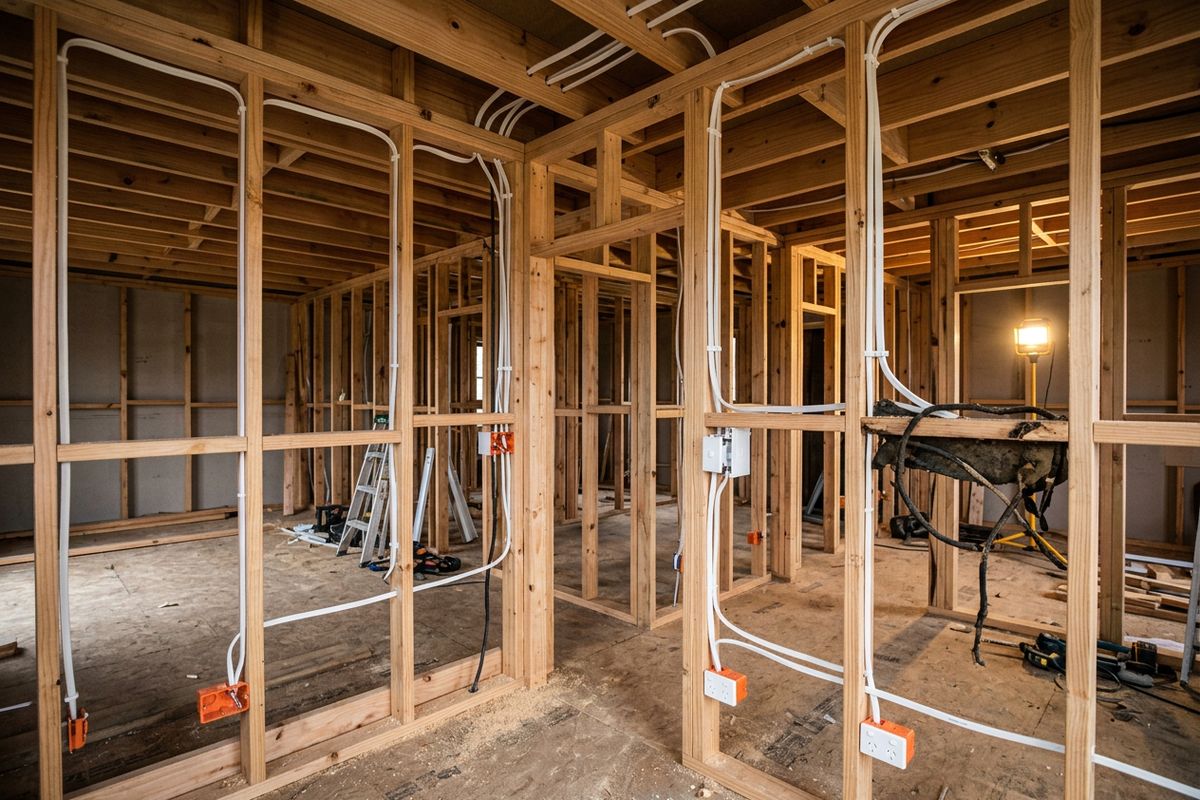
A full rewire replaces the cabling throughout the home, along with outdated outlets, switches, and usually the switchboard. The work is staged: the electrician runs new cabling through roof spaces, wall cavities, and under floors, which on an occupied home means some access holes in walls and ceilings that are patched afterward. The power is off in sections as circuits are changed over. A partial rewire, just the oldest or highest-risk circuits, is less disruptive and is often the practical middle ground for a home that isn't uniformly old.
Done properly, a rewire brings the whole installation up to the current AS/NZS 3000 wiring rules, including modern safety-switch protection, and the electrician issues a Certificate of Compliance for the work.
Living Through It
A common worry is whether the home stays liveable during a rewire. In most cases it does, the work is staged so power is only off in the area being worked on, and the job is planned around the household where possible. The disruption is real but temporary, and a rewire is usually a once-in-the-life-of-the-house event. Catching it before a fault forces the issue means it can be planned and budgeted rather than dealt with as an emergency.
What Drives the Scope
No two rewires are the same, and the scope is what determines the work involved. The size of the home, how many circuits it has, the type of construction (a single-storey brick-veneer is easier to access than a two-storey home with limited roof space), and whether the switchboard and outlets are being replaced at the same time all shape the job. Access is often the biggest factor, a home with a generous roof cavity and subfloor is far quicker to rewire than one where cabling has to be fished through tight or finished spaces. This is also why a partial rewire of just the ageing circuits can be a sensible, lower-impact option where the whole house doesn't need doing at once. An electrician scopes all of this during the assessment so there are no surprises mid-job.
Frequently Asked Questions
How long does a home rewire take?
It depends on the size of the home and whether it's a full or partial rewire. A licensed electrician gives a realistic timeline after inspecting the property; staging the work keeps the home liveable, with power off only in the section being worked on at the time.
How do I know if it's the wiring or just one faulty appliance?
A single faulty appliance usually trips one circuit and stops when it's unplugged. Wiring problems tend to be more general, repeated trips across circuits, flickering when loads switch on, or warm fittings. An electrician can test the circuits to pinpoint whether it's an appliance, a connection, or the cabling itself.
Can part of a house be rewired instead of the whole thing?
Yes. A partial rewire targets the oldest or highest-risk circuits and is often the sensible option for a home where only some sections are ageing. The electrician advises what's necessary after assessing the installation.
Is old cloth or rubber wiring dangerous?
It can be. The insulation on very old rubber and cloth-covered cabling becomes brittle and breaks down over decades, which raises the risk of faults, shorts, and fire. If that type of cabling is found in a home, it's worth having it assessed promptly.
Concerned About the Wiring in Your Terrigal Home?
Get a free, no-obligation assessment from a local licensed electrician serving Terrigal and the Central Coast.