

EV Charger Installation in Terrigal, Choosing the Right Charger for Your Home
Why the Choice Matters More Than the Speed
Not all home EV chargers are the same, and the differences matter more than most buyers expect. A charger is a long-lived fixture wired into a home's electrical system, so the choice isn't only about charging speed, it's about how the charger fits the house, the driveway, the switchboard, and the way the household actually uses the car. Most homeowners fixate on how fast a charger refills the battery, when the more useful questions are about convenience, control, and what the home's supply can support. Understanding the main options makes the conversation with an electrician far more productive.
Tethered or Untethered
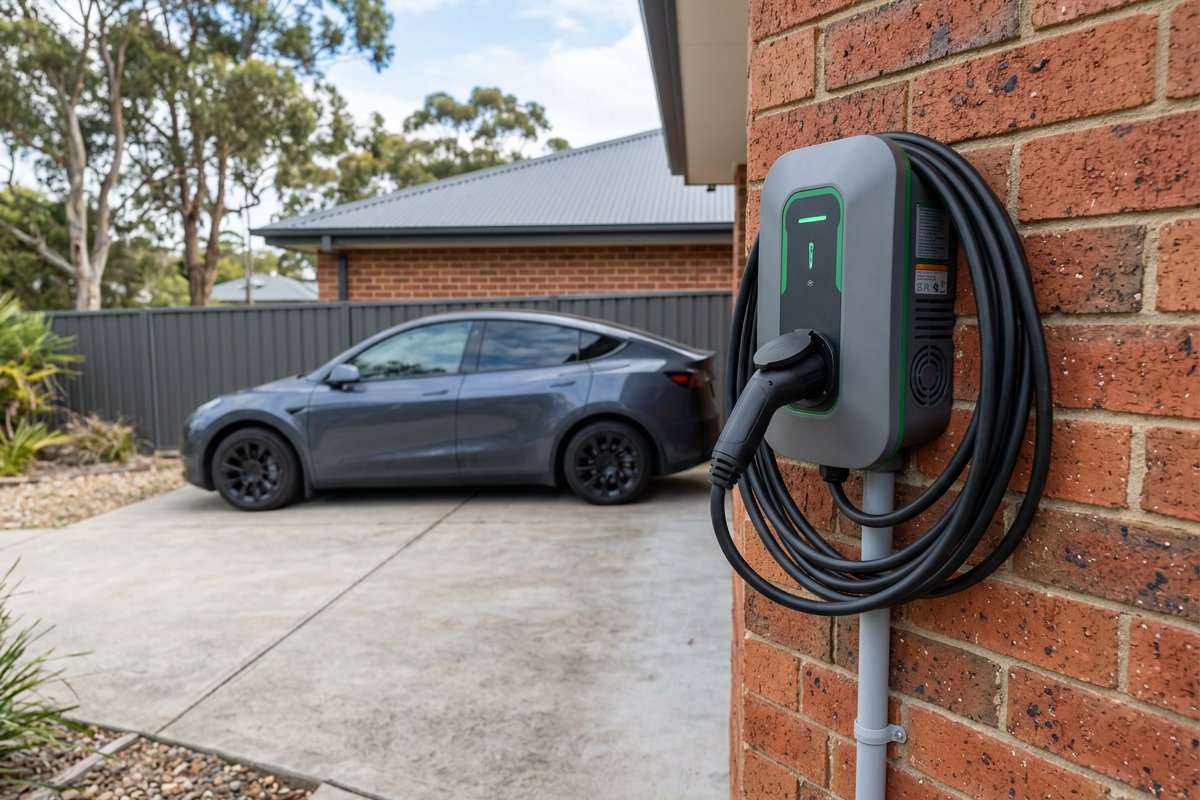
A tethered charger has the cable permanently attached, like a fuel bowser, convenient for daily use, no cable to fetch and connect, but the cable type and length are fixed. An untethered charger has a socket that takes a separate portable cable, which keeps the unit tidier, suits households with more than one type of plug, and makes a future cable upgrade simple.
For a single-car household charging the same vehicle every night, tethered is usually the easier daily experience, plug in and walk away. For a household with two EVs of different connector types, or one that wants the flexibility to change vehicles without changing the charger, untethered is the safer long-term choice. Neither is universally better; it comes down to how the driveway is used.
Smart or Basic
A basic charger is essentially a controlled high-current outlet, plug in, it charges. A smart charger adds scheduling, app control, and the ability to coordinate with a solar system or a time-of-use tariff. For a home with solar, a smart charger can be set to draw from daytime generation rather than the grid, which is where the running-cost advantage of an EV really shows. For a home charging overnight on an off-peak tariff, scheduling alone can deliver much of the same benefit by shifting the charge to the cheapest hours.
Smart chargers also help where a switchboard is close to its limit. Some include load management that automatically dials charging up or down based on what the rest of the house is drawing, so the charger doesn't trip the supply when the oven and air conditioning are running at the same time.
Single-Phase or Three-Phase
This one is decided largely by the home's supply. Most Central Coast homes are single-phase, which comfortably supports a standard home charger. Homes with three-phase supply can run higher-output chargers that refill a battery faster, but the faster charger is only worth it if the vehicle and the daily driving pattern actually need that speed. For typical commuting distances, an overnight charge on a single-phase unit is more than enough, the car sits in the driveway for far longer than it takes to charge. Paying for three-phase charging speed makes sense for high-mileage drivers, not for the average commute.
What the Install Involves
A home EV charger is hardwired by a licensed electrician, not simply plugged in. The job includes assessing the switchboard's spare capacity, running a dedicated circuit with the correct protection, mounting the unit within reach of where the car parks, and routing the cabling neatly, usually in grey conduit along the wall. If the switchboard is old or full, it may need work before a charger can be added safely, which the electrician checks during the assessment. Getting the location right matters too: a charger mounted where the cable comfortably reaches the car's port saves daily frustration.
Frequently Asked Questions
Can I just use the cable that came with my car?
The portable cable supplied with most EVs is intended for occasional use on a standard outlet and charges slowly, often taking most of a day for a meaningful top-up. A dedicated wall charger on its own circuit is faster, safer for daily use, and far easier on the home's wiring than repeatedly drawing high current through a general power point.
Do I need solar to make a home charger worthwhile?
No. A charger is convenient regardless of how the home is powered. Solar simply lowers the running cost by letting the car charge on self-generated power during the day, and a smart charger is what makes that pairing automatic rather than something you have to manage by hand.
Will adding a charger overload my switchboard?
It depends on the board's spare capacity and the home's existing load. The electrician assesses this first and recommends any switchboard work needed so the charger runs safely. Where capacity is tight, a smart charger with load management can often avoid the need for a larger upgrade.
How long does installation take?
A straightforward install is typically a few hours. Longer cable runs, switchboard upgrades, or three-phase work can extend it. The electrician confirms the scope after assessing the site, so there are no surprises on the day.
Adding an EV Charger in Terrigal?
Get a free, no-obligation site assessment from a local licensed electrician serving Terrigal and the Central Coast.